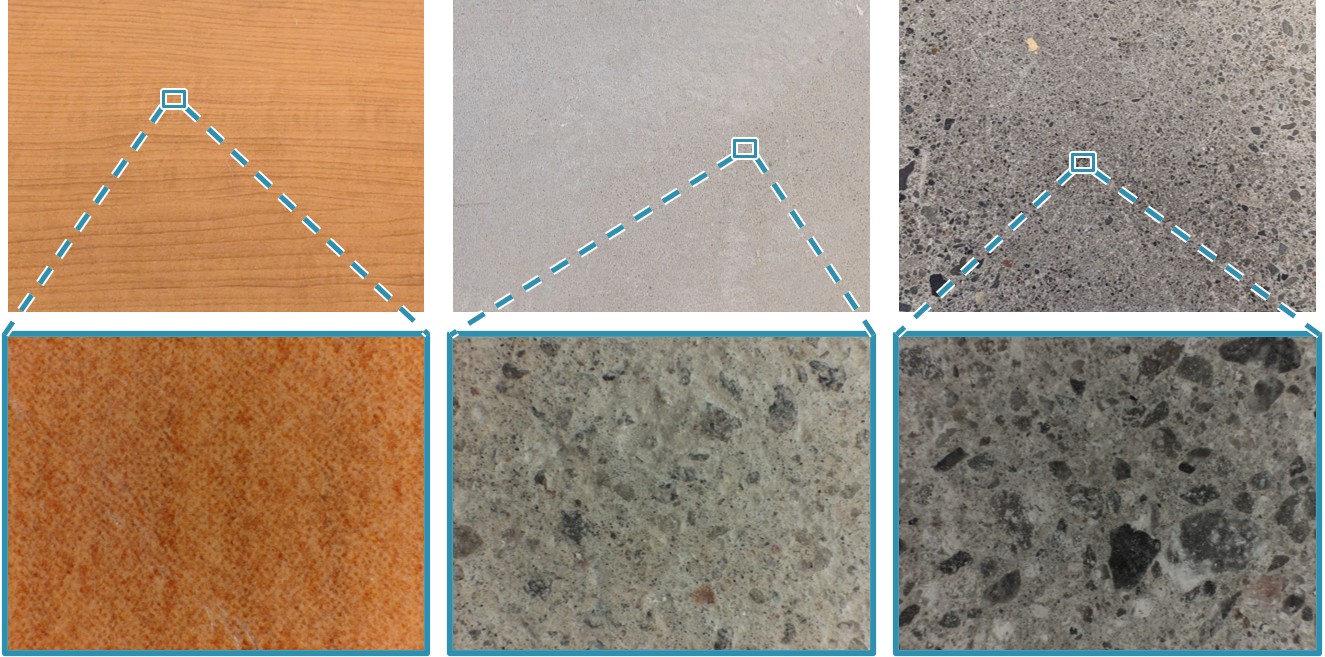
This work demonstrates how microscopic images of natural ground texture can enable a mobile robot to localize with tens-of-micrometers precision. Microscope optics reveal distinctive surface details even on materials that appear relatively textureless at larger scales. Increased magnification also makes small physical displacements easier to measure, allowing precise localization without artificial markers or modifications to the surface.
Key Contributions
- A geometric analysis relating optical magnification and image-matching uncertainty to physical localization precision.
- An adaptation of Lightweight Ground Texture Localization (L-GROUT) for microscopic imagery, incorporating optical calibration, camera modeling, and autofocus.
Performance Highlights
- 100% localization success across 1,007 test queries per surface on printed wood grain, terrazzo, and concrete, with 28–73 µm translation root mean square error (RMSE) relative to a calibrated gantry reference.
- A mobile robot costing less than $600 localized 100% of queries on printed wood grain and terrazzo and 98.4% on concrete using gantry-built maps, with 21–26 µm RMSE relative to image-registration references on valid comparison queries.
- Demonstrated micrometer-scale displacement sensing by tracking the thermal expansion of an aluminum rod through repeated heating and cooling cycles.