Research Projects
Most projects include a hands-on interactive demo you can run right in your browser — open a project to try it.
Scalable Ground-Texture SLAM
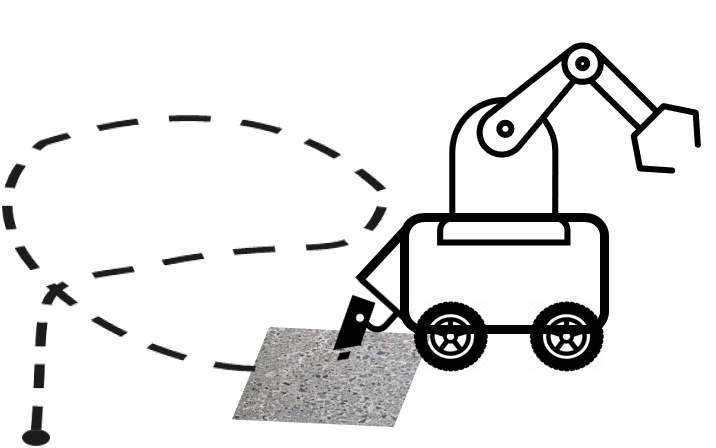
My current work develops a hybrid loop-closure architecture for scalable ground-texture SLAM. The system combines complementary localization methods to maintain robust tracking across surfaces with varying texture while limiting the memory required for each keyframe.
In experiments to date, this approach reduces per-keyframe memory by up to 55× relative to a direct-method baseline. A manuscript describing the system is in preparation.
Read more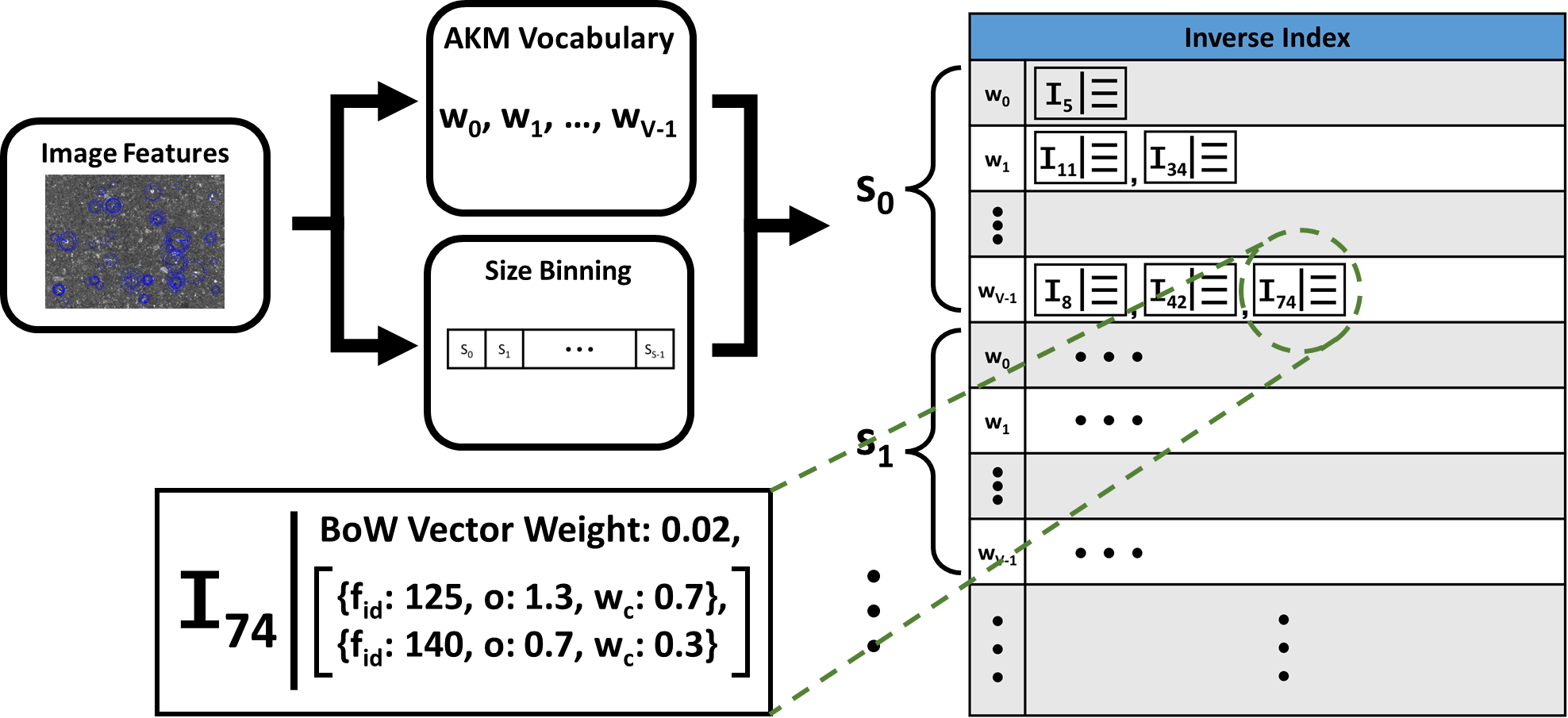
Improved Bag-of-Words Image Retrieval for Ground Texture Localization
GT-BoW is a geometry-aware bag-of-words image-retrieval system for ground-texture localization. It uses the fixed scale and consistent orientation of downward-facing imagery to reject visually similar but geometrically inconsistent matches, improving both global localization and loop-closure detection.
Key Contributions
- An approximate k-means vocabulary with soft assignment
- Scale-binned vocabularies and orientation-based geometric verification
- Separate high-accuracy and high-speed variants for global localization and loop closure
Performance Highlights
- Increased global-localization mean average precision from 0.026 to 0.559
- Detected nearly 3× as many loop closures as a standard DBoW baseline
Related Publication: "Improved Bag-of-Words Image Retrieval with Geometric Constraints for Ground Texture Localization" (ICRA 2025)
Explore the live demo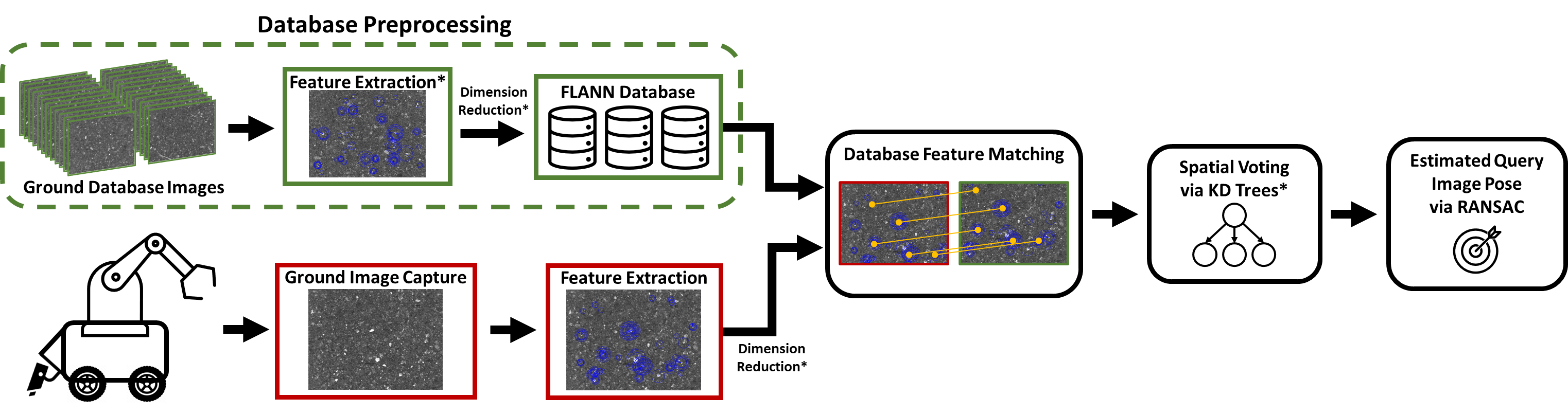
Lightweight Ground Texture Localization (L-GROUT)
L-GROUT is a lightweight global-localization system that matches natural ground texture observed by a downward-facing camera to a prebuilt map. It improves localization performance while reducing computation enough to run in real time on resource-constrained, single-board computers without GPU acceleration.
Key Contributions
- An improved method for selecting database features
- Locality-preserving dimensionality reduction that supports fast binary features
- A spatial-voting stage designed to retain accuracy in lightweight configurations
Performance Highlight
- Runs the complete localization pipeline at more than 4 Hz on a Raspberry Pi 4
L-GROUT provides millimeter-scale global localization without markers, installed infrastructure, or other environmental modifications.
Related Publication: "Lightweight Ground Texture Localization" (ICRA 2024)
Explore the live demo